


Guardian of Truth in an Orwellian World: The Artist's Role in a Dystopian Society
Updated: Mar 31
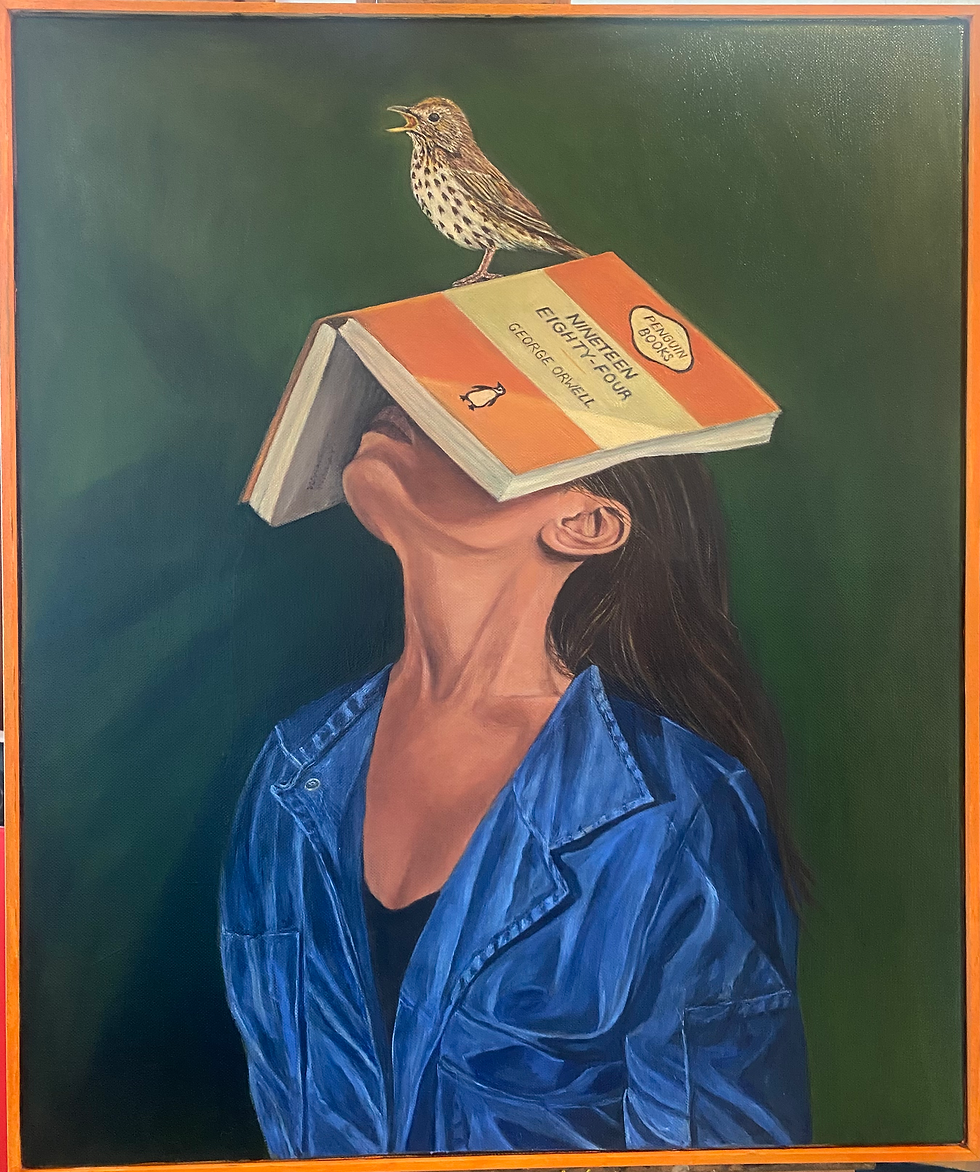
The world today often feels like a scene from George Orwell’s Nineteen Eighty-Four. Surveillance, control, and enforced uniformity shape many aspects of life, leaving little room for individuality. In this environment, artists face a unique challenge and responsibility. This post explores how art can serve as a beacon of truth and hope amid growing dystopian realities, inspired by a self-portrait that captures this tension.
The Symbolism Behind the Blue Overalls
The blue overalls worn in the self-portrait echo the uniforms described in Orwell’s novel. These garments symbolize conformity and the suppression of personal identity. Wearing them is a deliberate choice to highlight how society pressures individuals to blend in, erasing differences and dissent.
This visual metaphor connects the past and present, reminding us that the struggle against uniformity is ongoing. It also raises questions about how much freedom remains when everyone is expected to look and act the same.
The Song Thrush as a Symbol of Freedom
In contrast to the uniform blue overalls, the Song thrush bird represents freedom and truth. Known for its clear, melodious song, the bird sings openly and without fear. This stands in stark opposition to citizens living under constant surveillance, where speaking freely can have severe consequences.
The Song thrush symbolizes the artist’s role in society: to sing the truth, to reveal what others might want to hide, and to inspire hope. Its presence in the self-portrait serves as a reminder that even in dark times, truth can be voiced and heard.
Artists as Guardians of Truth
The phrase "Artists are the guardians of truth," borrowed from Paul Robeson, captures the essence of the artist’s mission in a dystopian world. Artists observe, interpret, and challenge the status quo. Through their work, they expose injustices and encourage critical thinking.
Art can take many forms—paintings, music, literature, or performance—but its power lies in its ability to communicate complex ideas and emotions. In societies where information is controlled or manipulated, art becomes a vital tool for preserving reality and encouraging resistance.

The Power of Hope in Dark Times
Despite the bleakness of an Orwellian society, the self-portrait also expresses hope. The presence of the Song thrush and the artist’s commitment to truth suggest that change is possible. Art can inspire courage and resilience, reminding people that their voices matter.
Hope is not passive; it requires action. By continuing to create and share honest work, artists contribute to a future where freedom and individuality can thrive again.

Comments